


The workers’ compensation system in Washington State assists workers who are injured on the job. It provides vital benefits to cover medical bills, lost wages, and, when necessary, retraining for those who cannot return to their previous line of work.
However, filing a workers’ compensation claim is no guarantee that your claim will be approved. Your claim may be denied due to a pre-existing condition, a lack of medical evidence, or your employer disputing that the injury is work-related.
While you can pursue a workers’ compensation appeal on your own, hiring an experienced workers’ comp lawyer can significantly improve your chances of success. A knowledgeable lawyer understands the complexities of Washington’s workers’ compensation system, and their legal guidance can help ensure you receive full compensation for your work-related injury.
How Many Washington State Workers’ Compensation Claims Are Denied?
There’s no centralized database that tracks and tallies how many workers’ compensation claims are made or denied each year. Each state collects and maintains its own data, though some private organizations collect and aggregate data.
Washington State maintains data about workers’ compensation claims through the Department of Labor and Industries. Below are two charts with data from L&I showing the number of workers’ compensation claims made between 2010 and 2024 and the number of denied workers’ compensation claims:
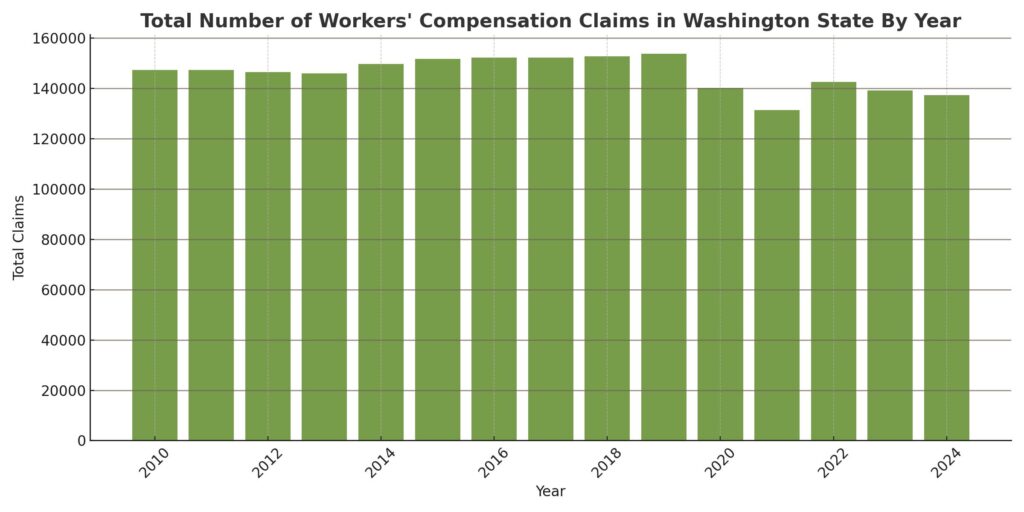
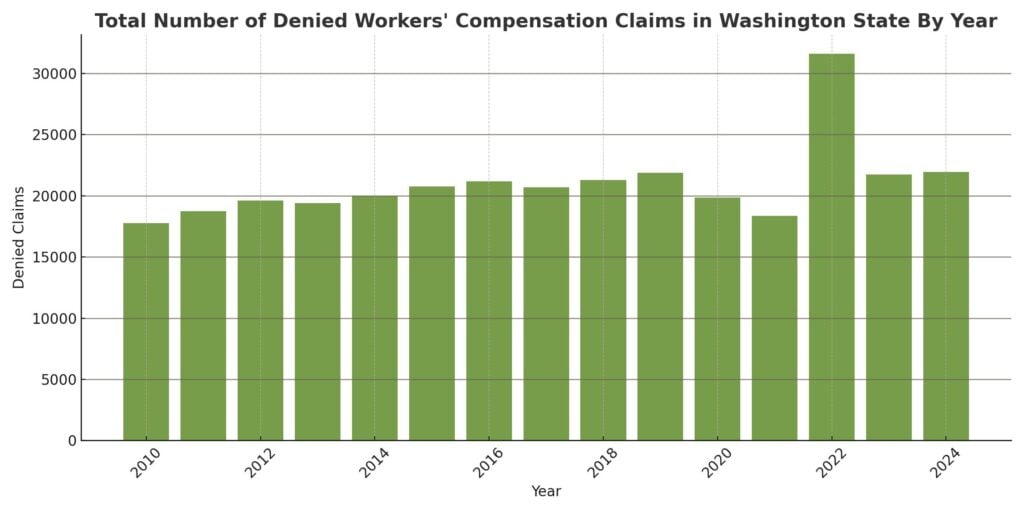
While the total number of workers’ compensation claims and denied workers’ compensation claims remained relatively steady between 2010 and 2019, between 2020 and 2024, the overall denial rate began to climb.
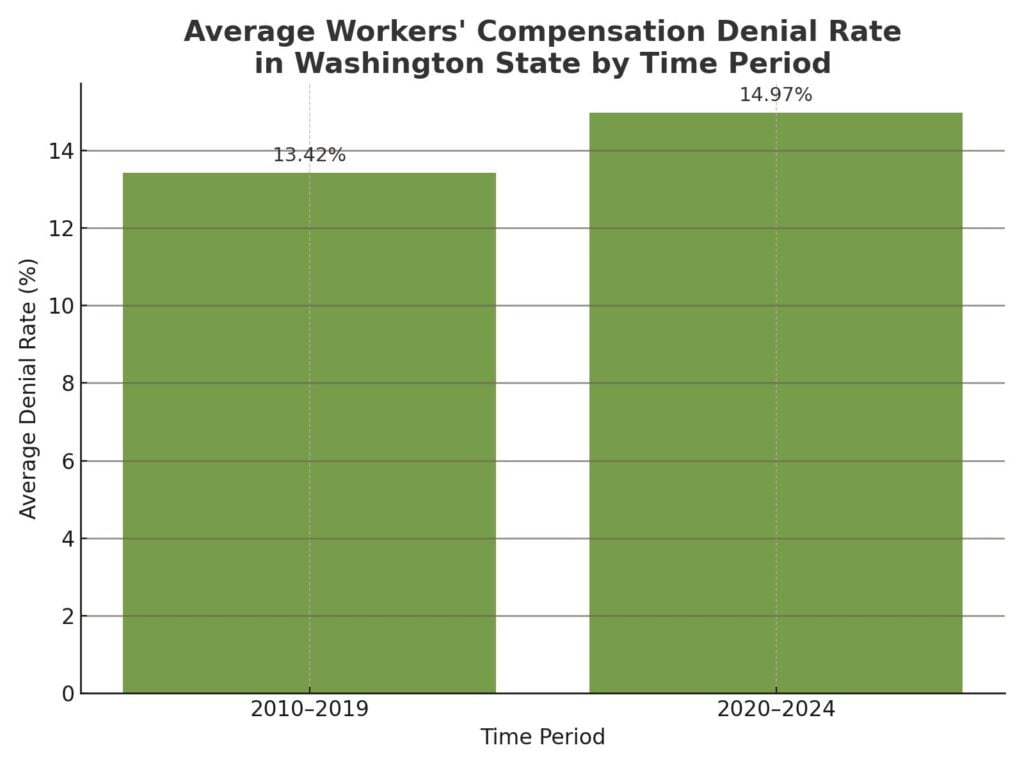
Between 2010 and 2019, the overall average workers’ comp denial rate was 13.42%. However, between 2020 and 2024, the average denial rate was 14.97%, representing an 11.52% increase in the denial rate compared to 2010 to 2019.
Common Reasons Why Workers’ Compensation Claims Are Denied
The data points to a marked increase in Washington State denying workers’ comp claims over the last few years. Fortunately, there are things you can do to ensure your claim is approved. Here are common reasons why a workers’ comp claim is denied.
When Is an Injury Work-Related?
To better understand why L&I denies workers’ comp claims, it’s important to understand when a work injury is covered. The standards for determining whether an injury is work-related are detailed and strict. According to Washington State Law, a work-related injury happens when:
- The injury occurred at your job site and while you were working.
- You were injured off-site while performing your work duties, i.e., doing something for the benefit of your employer.
- You were traveling for work or, in some cases, working from home.
- It happened because of something that happens at work, like you were lifting something or repeatedly exposed to loud noises.
- Work equipment or materials were involved, like you were driving a forklift.
- Your job duties aggravate a pre-existing condition, which leads to you needing additional medical treatment, missing work, or even death.
When an Injury Isn’t Work Related
If your injury occurred outside of the above circumstances, then it may not be a workplace injury. Your claim might be denied if you were injured when:
- You were performing a purely personal task unrelated to your job duties, such as checking personal emails, shopping online, or making personal calls.
- You were on your lunch break, off the clock, and engaged in personal activities, such as eating or running errands, e.g., choking on a sandwich or slipping while picking up a takeout order.
- Your injury happened while you were off duty, such as riding your bike over the weekend, traveling for personal reasons, or doing home improvement projects.
- Injuries that occur while driving to or from work, including in a company parking lot or on access roads, are generally not covered by workers’ compensation unless you were performing a specific job duty during that commute.
- If you’re traveling for work and take a personal side trip or detour, any injury during that detour is not considered work-related.
- Getting the common cold or flu — even at work — typically does not qualify, unless the illness can be traced directly to a workplace exposure (e.g., tuberculosis or hepatitis contracted at work).
- A mental health condition will not be considered work-related unless a licensed professional explicitly states that the condition was caused or aggravated by workplace factors.
If your symptoms start at work, you may or may not have a workers’ comp claim. To have a valid claim, you must have medical evidence that the injury meets the criteria for a workplace injury. Simply feeling ill at work does not mean your claim will be approved.
Inaccurate or Incomplete Paperwork
Labor and Industries require detailed and specific information for every workers’ comp claim. Failure to provide the correct information will likely lead to a processing delay or for L&I to deny your claim.
Before Filing a Workers’ Compensation Claim
It’s critical to take the following steps to protect your health and legal rights.
- Seek immediate medical treatment. Even if your injury seems minor, receive treatment as soon as possible. Delaying medical care can worsen your condition and complicate your claim.
- Notify your employer. Report the injury to your supervisor or HR department right away. Written notice is best, even if you’ve already mentioned your workplace injury verbally.
If you work for a self-insured employer, you must file a claim directly with your employer, not L&I. Contact your employer’s HR department for assistance.
When You File Your Workers’ Comp Claim
Failure to include the following information could lead to your L&I claim being rejected:
- Where the injury happened (e.g., job site, warehouse, office)
- The names and phone numbers of any witnesses
- Name, address, and contact information for your employer when your accident occurred
- Your hourly wage or salary, hours worked per week, and any recent pay stubs (if they’re available)
- Full names and birth dates of your spouse and any children or dependents
If you received medical treatment after the accident happened, you’ll also need to provide:
- The name of the doctor who treated you
- The name of the hospital or clinic where you were treated

Reporting the Accident or Injury too Late
Reporting your injury as soon as possible is critical. It helps you more easily connect the dots from your workplace injury to your current situation and support your workers’ compensation claim. However, not every injury results in immediate symptoms. For example, a repetitive motion injury like carpal tunnel syndrome takes weeks or months to develop, and you may not realize your job is to blame for your condition until a doctor tells you.
Because it can take time to link your injury to your job, it’s crucial to act promptly. You have one year and one day from the date of your injury to report it to L&I. Additionally, you have two years from the date a doctor informs you that your condition is work-related to file a claim.
Missing either of these deadlines can result in your claim being denied.
Unauthorized Medical Treatment
Labor and Industries instructs injured workers to seek medical care as soon as possible. If the injury occurred at work, you should get on-site aid first. But if that’s not enough, an injured worker should go to the emergency room or their healthcare provider to get the necessary medical care.
However, if you need additional medical treatment for your injury after the initial visit and you are actively pursuing a workers’ compensation claim, L&I requires you to see a doctor from their network. If you don’t, your workers’ comp claim may be denied. You also cannot seek a second opinion unless your L&I claims manager approves it first.
Additional Reasons Your Workers’ Comp Claim May Be Denied
Other reasons your claim may be denied include:
- Your employer disputes responsibility for your injuries or argues that the injury did not occur while you were on the job.
- There is a lack of medical records or insufficient medical evidence to support your claim.
- You were intoxicated at the time of injury.
- Your misconduct contributed to your injury. For example, you and another employee were engaged in horseplay when the accident occurred.
- If you have a pre-existing condition that may have contributed to the accident or the severity of your injury, your claim may be denied.
>>Learn More: These Critical Mistakes May Ruin Your L&I Claim
What to Do When Your Workers’ Compensation Claim Is Denied
If your workers’ comp claim is denied, you have the right to protest or appeal it. Keep in mind that while you have the right to protest or appeal a claim denial, your employer also has the right to protest and appeal L&I’s decisions.
How to Protest a Denied Claim
If you choose to protest your claim denial, you have to file a written protest with your claim manager within 60 calendar days from when you received the decision. You’ll gather additional evidence (medical records, video recordings, etc.) to strengthen your case.
As part of your protest, you must include:
- An explanation of why you disagree with the decision or claim denial letter
- The nature and type of decision.
- Information from your medical provider outlining your current medical condition, a description of your treatment, and current prognosis (only if your claim was closed).
- Your name and claim number on every page of the protest.
You can submit your claim online or by regular mail. As long as you file the protest within 60 days, L&I will issue another decision. If you disagree with that decision, you can appeal to the Board of Industrial Insurance Appeals.
How to Appeal a Denied Claim
The appeals process is similar to a protest but follows a slightly different path. You, your employer, and medical providers who disagree with the decision may appeal to the Board of Industrial Insurance Appeals (BIIA). You do not have to file a protest with L&I before filing an appeal.
As with a protest, the appeals process must be initiated within 60 days of receiving either L&I’s decision or the results of your protest. If the BIIA does not receive a written appeal within that timeframe, the decision will stand. Your written appeal must include:
- Your name and claim number on every page
- The date of the L&I decision you want to appeal and its description
- Reason(s) why you disagree
- Your name, mailing address, and phone number
- The city you want the proceedings held in
- Any information that supports your appeal
Your appeal can be submitted online, by regular mail, or in person.

Do I Have to Hire A Workers’ Compensation Lawyer to Challenge a Denial?
You are not required to hire a workers’ compensation attorney to pursue your claim, but navigating the workers’ comp system can be challenging and often overwhelming. An experienced workers’ comp lawyer can be a critical advocate, ensuring your rights are protected and helping you pursue fair compensation for your work-related injury. A workers’ comp lawyer can:
- Give you objective advice and options about your claim
- Gather additional evidence to ensure you receive the workers’ compensation benefits you’re entitled to
- Help you choose the best course of action
Walthew Law Firm Can Help
When you hire an experienced workers’ comp attorney, you’ll have someone on your side who understands the challenges of workers’ compensation cases and will fight for your right to compensation for your medical expenses, lost wages, and other benefits you have a right to.
Walthew Law Firm brings over 90 years of experience handling workers’ compensation cases in Washington State. Our team of experienced workers’ comp attorneys works tirelessly to ensure you receive the maximum workers’ compensation benefits. Contact us today for a free consultation to learn more about your options.